- Whatsapp: 8613738300923
- Email: [email protected]


Author: Gencel Stainless Steel Engineering Team — 3A and ISO 9001 certified manufacturer of stainless steel sanitary pipe fittings, valves and pipe supports for food, beverage, dairy, pharmaceutical and chemical OEM projects. Reviewed: September 2026.
In procurement spreadsheets a round pipe holder, a pipe clamp and a pipe hanger are frequently listed side by side, as though they were three variations of the same part. On site they do three quite different jobs. A round pipe holder fixes round tube to a frame or skid. A pipe clamp either joins two pipe ends around a gasket or grips a pipe to a surface, depending on which trade you ask. A pipe hanger carries a pipeline from overhead structure. Specifying the wrong one produces sag, joint leaks, crevice corrosion and audit findings, none of which appear on the purchase order until the line fails.
This article compares round pipe holder vs pipe clamp vs pipe hanger the way a B2B buyer actually needs it: what each part is engineered to do, where the load really goes, how grade and surface finish change the decision in hygienic service, and how to write a specification a supplier can quote against in one pass. It is written for OEM machine builders, EPC contractors, distributors and plant engineers sourcing stainless steel pipe hardware for food, beverage, dairy, pharmaceutical, cosmetic and fine chemical projects.
The confusion is not sloppiness. It is trade vocabulary, and every industry uses it slightly differently.
● In sanitary processing, “clamp” almost always means a tri-clamp union: the coupling that compresses a gasket between two ferrules to make a demountable, leak-tight joint.
● In mechanical and plumbing work, “pipe clamp” frequently means exactly what we call a round pipe holder: a two-piece metal collar that wraps the pipe outside diameter and bolts it to a wall, frame or strut.
● In building services and utilities, the component that carries pipe from above is a pipe hanger: a rod, strap or bar assembly dropped from the ceiling structure.
One word, three jobs. The only reliable way to buy is to describe the task and the load rather than trusting the name, which is why every serious RFQ in this category should include a drawing or a structured worksheet.
A round pipe holder is a stainless steel collar that grips the outside diameter of a round tube or pipe and transfers its load into a supporting structure. It does not join two pipes, and it does not seal anything. Its whole purpose is position control and load transfer.
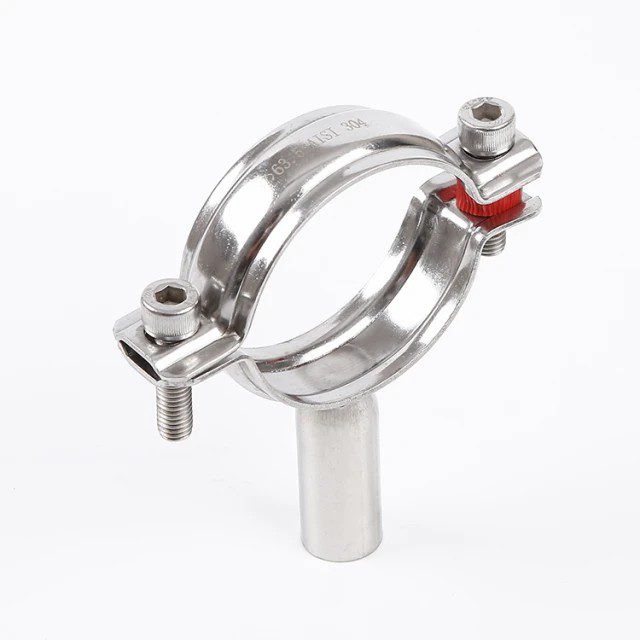
In practice a round pipe holder performs four functions:
● It carries dead weight — the mass of the tube, the product inside it, and any insulation — into the frame, skid or wall.
● It damps vibration from pumps, homogenisers and positive-displacement fillers, which is usually where small-bore connections crack first.
● It maintains slope so the line drains completely, because a section that sags becomes a low point where rinse water and product sit between batches.
● It manages thermal movement during hot cleaning cycles of roughly 80–90 °C, holding position while allowing controlled axial travel.
Gencel builds round pipe holders in SS304 and SS316L (EN 1.4301 / 1.4404), covering 1/2″–12″ and DN10–DN300, with clamp, weld, thread or weld-thread mounting ends and polished surfaces at Ra 0.8–0.5 μm. Dimensions, grade options and mounting variants are listed on the round pipe holder product page.
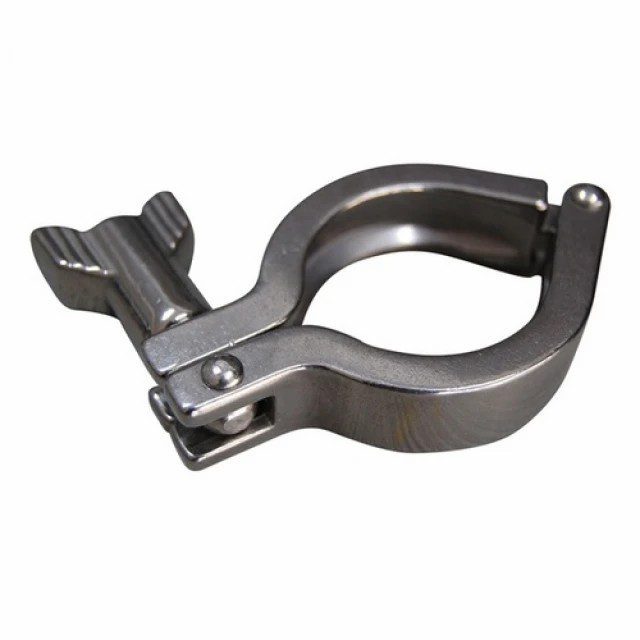
In hygienic piping a sanitary pipe clamp is a joint device. Two stainless ferrules are brought face to face with a gasket between them, and the clamp body wraps around the ferrule shoulders to apply the compression that creates the seal. Remove the clamp and the joint can be pulled apart for cleaning, swabbing or modification without cutting the line.
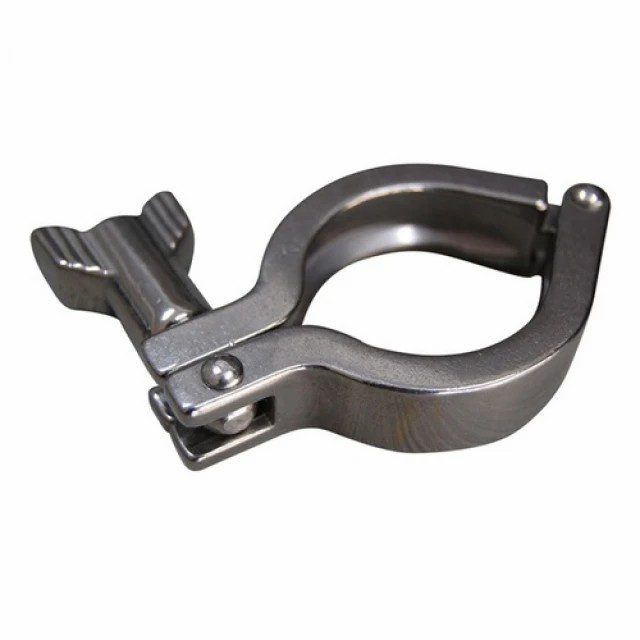
That is a fundamentally different task from holding a pipe still. A tri-clamp union is not designed to be a structural anchor. Hanging weight off one puts bending load through the ferrule weld and the orbital joint behind it, which is a common origin of leaks at a product contact point. The general range is shown on our sanitary pipe clamp page.
Clamp families you will meet in most specifications:
● Single pin, double pin and heavy duty clamp — built for larger sizes and higher hoop loads, typically on main transfer lines and higher mechanical duty.
● High pressure clamp — specified where the joint must resist internal pressure; always request the derating curve rather than a single number.
● Bolted clamp — a bolted rather than pinned body giving uniform, controlled compression. Our article on how a bolted clamp works covers the mechanism in detail.
● Three piece clamp and standard clamp — the general-purpose bodies used for everyday line assembly.
Materials match the holder family: SS304 / SS316L, sizes 1/2″–12″ (DN10–DN300), with the body polished to Ra 0.8–0.5 μm because it sits in the splash zone. The one critical difference is the gasket, which is a product contact part and must be specified separately — EPDM, silicone, PTFE, FKM or Buna-N, matched to your fluid, temperature and cleaning chemistry.
A pipe hanger carries a pipeline from structure above it. The load path is vertical tension: a rod, strap or solid bar runs from a ceiling, beam or strut channel down to a collar that surrounds the tube, and the weight of the line is taken by whatever is overhead.
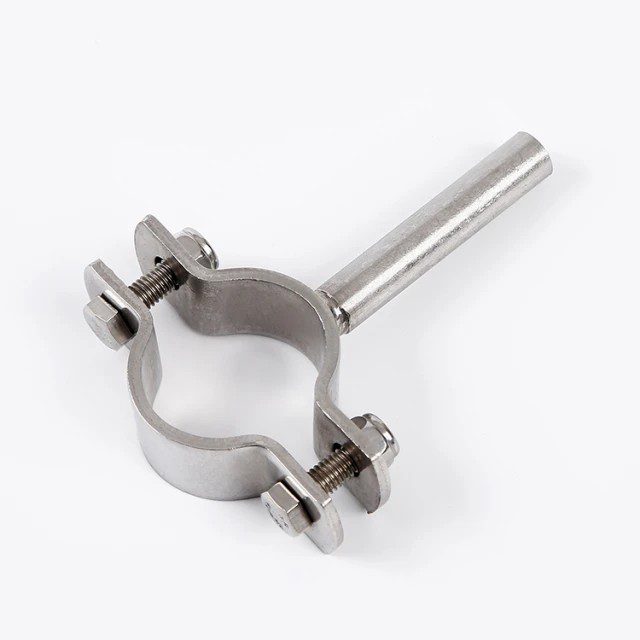
Where round pipe holder vs pipe hanger is the live choice, it comes down entirely to where your structure sits.
Hangers are the default answer in three situations:
● Long horizontal runs with no machine frame to anchor to, such as service corridors, ceilings over process halls and utility headers.
● Overhead drops into vessels and tanks where the line arrives from above.
● Lines needing periodic height adjustment, because a threaded rod and nut arrangement lets crews re-level without cutting anything.
Our round pipe hanger with solid bar is the hygienic version of that device: SS304 / SS316L, 1/2″–12″ (DN10–DN300), polished to Ra 0.8–0.5 μm, and shaped so the tube contact area stays crevice-free through daily washdowns.
The table below puts the three options on the same set of purchase-relevant factors.
| Factor | Round pipe holder | Pipe clamp (sanitary union) | Pipe hanger |
|---|---|---|---|
| Primary job | Position control and load transfer into structure beside the pipe | Joining two ferrules around a gasket to make a demountable seal | Carrying pipe from overhead structure |
| Load it carries | Dead weight, vibration, thermal movement | Hoop compression on the gasket; not a structural anchor | Vertical tension of the line and its contents |
| Where the load goes | Machine frame, skid, wall or strut next to the pipe | Into the two pipe ends either side of the joint | Ceiling, beam or channel above the pipe |
| Does it seal the line? | No. It sits outside the pipe | Yes, through the gasket between ferrules | No. It sits outside the pipe |
| Size range | 1/2″–12″, DN10–DN300 | 1/2″–12″, DN10–DN300 | 1/2″–12″, DN10–DN300 |
| Materials | SS304 / SS316L, EN 1.4301 / 1.4404 | SS304 / SS316L body plus a separately specified gasket | SS304 / SS316L, EN 1.4301 / 1.4404 |
| Surface finish | Ra 0.8–0.5 μm polished | Ra 0.8–0.5 μm on the body | Ra 0.8–0.5 μm polished |
| Removal without tools | Yes on hinged and two-piece versions | Yes, via wing nut or pin | Yes, from the rod or strap |
| Typical misuse | Asked to join two pipe ends | Asked to carry the weight of a line | Specified where no overhead structure exists |
| Main cost driver | Load rating, liner type, specified finish | Size, body type, gasket grade | Rod length, bar size, specified finish |
Every comparison collapses into a single question: where does the weight go?
● Structure beside the pipe — choose a round pipe holder.
● Structure above the pipe — choose a pipe hanger.
● No structural load, just two pipe ends to connect — choose a pipe clamp, and support the pipe separately.
Support spacing then follows from line size, fluid density, insulation thickness and any shock loading from pumps or fast-acting valves. Do not copy a spacing rule of thumb between projects. Process piping support layouts are designed against ASME B31.3 or EN 13480 practice, and hanger hardware itself generally falls under MSS SP-58 for manufacture and MSS SP-69 for selection. Ask the supplier to confirm spacing and hardware grade against your specific line instead of accepting a generic table — that single step prevents more failures than any product upgrade.
The SS304-or-SS316L question sits behind most delayed RFQs in this category.
Choose SS316L (EN 1.4404) whenever the holder body, clamp body or hanger strap can be reached by chlorides, brine, salty sauces or aggressive cleaning chemicals. The molybdenum content delivers pitting resistance that SS304 does not offer, and practically every food, dairy, pharmaceutical and cosmetic line belongs in that group.
SS304 (EN 1.4301) stays acceptable and cheaper for dry utilities, ambient water lines and services that rarely see chloride carryover.
Finish is the second half of the decision, and it is not cosmetic. An Ra value determines how easily the surface releases soil and how quickly it dries between washes. Ra 0.8 μm is the practical hygienic benchmark for this hardware; Gencel supplies 240–320 grit polishing to Ra 0.8–0.5 μm. Always write two things into the enquiry: the Ra target itself, and whether it covers every surface in the splash zone or only the main body. Our dedicated article on what a sanitary round pipe holder is goes deeper into grade selection for specific process media.
All three families are normally supplied to the same dimensional envelope, which makes mixed specifications easier than most buyers expect:
● Size: 1/2″–12″, equivalent to DN10–DN300.
● Material: SS304 / SS316L to EN 1.4301 / 1.4404.
● Certificates: 3A and ISO 9001.
● Mounting ends on the support side: clamp, weld, thread or weld-thread.
● Inner and outer surface: Ra 0.8–0.5 μm, 320/240 grit polishing.
For the joint itself, quote both the imperial tube outside diameter and the DN size, and tell the supplier which clamp geometry your plant is standardised on. ISO 2852 and DIN 32676 are the usual reference points for ferrule and clamp dimensions. A union that looks correct but does not match your existing ferrule profile will not seal, and it remains one of the most common causes of mismatched deliveries on skids built from several vendors. The whole family of supports and connectors is grouped in our sanitary pipe fittings category.
In hygienic service the choice of round pipe holder vs pipe clamp vs pipe hanger changes slightly, because you are no longer comparing only strength. You are comparing shapes.
● Contact geometry — a support that touches the tube across a wide flat creates a ledge where soil survives a rinse. Look for narrow, radiused contact or a liner that spreads load without trapping residue.
● Water shedding — horizontal surfaces collect rinse water that later drains onto product surfaces. Prefer geometry that drains rather than cups.
● Liners — where a stainless line meets a carbon steel frame, the liner is doing galvanic isolation as well as cushioning, and it is rarely included by default. Name the material in the RFQ.
● Elastomer reach — only the clamp brings a product contact elastomer into the assembly, so its material and certificate documentation belong in your hygiene file.
None of the three is automatically more hygienic. A holder with a wide crevice is worse than a clamp without one, and a hanger with exposed threads above the product zone is worse than a welded holder. Ask for drawings showing the contact path, not just a datasheet.
Get the spec confirmed before you buy.
Send us your tube outside diameter, load, temperature and finish target. Our engineering team confirms grade, size and mounting, then quotes within 24 hours.
Work through these seven points in order and you avoid the re-quote cycle almost entirely:
● Name the job, not the part: support, slope control, suspension or sealing. Each maps to exactly one of the three.
● Fix the load: tube size, filled weight, insulation, any pump or valve shock load, and whether vibration is continuous or intermittent.
● Identify the structure: frame beside the pipe, ceiling above it, or neither.
● Set the grade: SS316L for chloride and cleaning chemical service, SS304 for ambient clean utilities.
● State the finish: Ra 0.8–0.5 μm across the splash zone, and say precisely which surfaces it applies to.
● Choose the mount: clamp, weld, thread or weld-thread ends for holders; rod or solid bar for hangers.
● Write the compliance requirement: liner material, gasket material where a clamp is involved, and the standard your plant is audited to — 3A, SMS, IDF, RJT, DIN or ISO.
● Specifying only the nominal pipe call-out — 2″ nominal bore and 50 mm tube outside diameter are not the same dimension, and each needs its own holder.
● Treating a pipe clamp as an anchor — the load goes through the ferrule weld, which is where the leak will appear.
● Forgetting insulation — it adds dead weight and changes the fitted size of the holder or strap.
● Mixing stainless and carbon steel without a liner — galvanic corrosion starts at the contact point, usually out of sight.
● Ordering custom sizes from a drawing alone — request a first-article sample before releasing a batch.
Copy this table into your RFQ or print it and hand it to your maintenance team. It collects every value a supplier needs to quote a round pipe holder, pipe clamp or pipe hanger without a follow-up email, and it has no scripted elements, so it prints cleanly from any browser.
| Checkpoint | What to record | Reference on this page | Your value |
|---|---|---|---|
| Tube outside diameter | Measured OD, not the nominal call-out | 1/2″–12″, DN10–DN300 | |
| Line contents and temperature | Fluid, density, cleaning cycle temperature | Hot cleaning typically 80–90 °C | |
| Support or suspension | Structure beside the pipe, or above it | Holder versus hanger decision | |
| Load per support point | Filled pipe weight, insulation, shock loads | Calculated per support, not per metre | |
| Vibration source | Pump, homogeniser, filler, none | Determines damping need | |
| Material grade | SS304 or SS316L | EN 1.4301 / 1.4404 | |
| Surface finish | Ra target plus which surfaces it covers | Ra 0.8–0.5 μm standard option | |
| Mounting ends | Clamp, weld, thread or weld-thread | Stated separately per line | |
| Liner or gasket | Elastomer where required | Specified apart from the metal body | |
| Certificate package | Scope required for size and finish | 3A and ISO 9001 | |
| Quantity and lead time | Stock versus production order | Confirmed before you commit dates |
Have a completed worksheet but no quotation yet?
Attach it to an enquiry and our team will return a priced specification for holders, clamps and hangers in one consolidated package.
Gencel Stainless Steel manufactures all three families under one roof, which removes the usual interface problem: your holders, clamp bodies and hangers arrive with consistent grade, consistent finish and a single certificate package.
● Conformity — manufactured to 3A, SMS, IDF, RJT, DIN and ISO standards, with 3A and ISO 9001 certification.
● Range — 1/2″–12″ / DN10–DN300 across holders, clamps and hangers, in SS304 and SS316L.
● Finish — 240–320 grit polishing to Ra 0.8–0.5 μm held to the same target across the whole family.
● Flexibility — OEM and custom sizes supported under confidentiality, with mixed-container consolidation for distributors.
● Engineering support — grade, size and mounting confirmed before quoting, so nothing is left ambiguous.
For larger projects we quote the three families as one line-item package, which is how most OEM machine builders avoid the version conflicts that appear when three different suppliers each make one part of the same support system.
A round pipe holder is a support that carries load into a frame or wall. A sanitary pipe clamp is a coupling that compresses a gasket between two ferrules to seal a joint, not carry weight.
Choose a holder when there is structure beside the pipe, such as a skid frame or wall. Choose a hanger when the only available structure is overhead and the line has to be carried downwards.
No. A sanitary clamp is designed to seal a joint, not to carry weight. Hanging load from one puts bending stress through the ferrule weld and usually appears later as a leak at the joint.
Gencel supplies 1/2″–12″, equivalent to DN10–DN300, covering small-bore sampling lines through to main transfer headers. Custom dimensions are supported for OEM projects.
Choose SS316L (EN 1.4404). Salt, brine, saline sauces and aggressive cleaning chemicals pit SS304, and most food, dairy and pharmaceutical lines meet one of those daily.
Ra 0.8 μm is the practical hygienic benchmark. Gencel offers 240–320 grit polishing to Ra 0.8–0.5 μm, and you should state exactly which surfaces the target applies to.
Gencel manufactures to 3A, SMS, IDF, RJT, DIN and ISO standards under 3A and ISO 9001 certification. Always request the certificate scope for the exact size and finish you are buying.
No. Any rating derates with temperature, gasket material and tube diameter. Ask your supplier for the pressure–temperature curve for the exact assembly you intend to install.
The round pipe holder vs pipe clamp vs pipe hanger decision is a load path question before it is a product question. Structure beside the pipe points to a holder, structure above it points to a hanger, and a joint that needs opening for cleaning points to a clamp that is then supported by one of the other two. Grade and surface finish are the two specifications that follow, and they decide whether the part survives your cleaning chemistry.
Gencel Stainless Steel supplies complete support and connection families in SS304 and SS316L from 1/2″–12″ (DN10–DN300), with 3A and ISO 9001 certification, Ra 0.8–0.5 μm polishing and OEM support for custom dimensions.
Talk to an engineer before the next order.
Tell us your tube size, load, grade and finish requirement. We confirm the full specification and quote holders, clamps and hangers as one package.
What Is a Sanitary Round Pipe Holder?
Complete Guide to Types of Sanitary Fittings
Stainless Steel High Pressure Clamp: Features, Benefits, and Applications
How to Choose High Pressure Clamp: 7-Point Selection Checklist
Why BSPT Pipe Holders Are Widely Used in Industrial Piping Systems



STAINLESS STEEL&GENCEL;
Privacy Policy | SiteMap
Copyright GENCEL STAINLESS STEEL CO.,LIMITED
 Optimized by Seraphinite Accelerator