- Whatsapp: 8613738300923
- Email: [email protected]


A Stainless Steel Sheet Plate is not maintenance-free. It is passive-film-dependent. The chromium oxide layer that protects it is a few nanometres thick, and it can be damaged or never form properly if the material sits in the wrong place for a few weeks — in a damp warehouse, under a tarpaulin, or inside a container crossing the equator.
The result is tea staining, rust spots, white pitting or discolouration that is expensive to remove and often appears at the worst moment: after the goods have arrived and the customer has opened the pack. This guide sets out what actually causes storage and transit corrosion, and the practical controls that prevent it, from mill dispatch to the fabrication floor.

Corrosion during storage is almost always one of five mechanisms.
Chloride attack. Sea air, salt spray from roads, cleaning chemicals and even some hands carry chlorides that break down the passive film locally and start pitting.
Condensation cycling. Warm humid air meeting a cold plate forms a continuous water film. Repeated wet-dry cycles concentrate chlorides and oxygen at the same spots, which is why staining appears in lines and patches.
Carbon steel contamination. Grinding sparks, wire brush bristles, forklift wear particles or carbon steel slings embed iron into the stainless surface. The iron rusts, and the stain looks like the stainless itself has failed.
Trapped water and poor ventilation. Sheets stacked flat with water between them, or wrapped while still warm, create a stagnant electrolyte that cannot dry out.
Chemical exposure. Acid or chloride vapours from nearby drums, or residues of pickling paste left on the surface, attack the material slowly and invisibly.
None of these require the plate to be defective. They are handling and environment problems, which means they are preventable.
Store on racks or dunnage at least 150 mm above the floor, never directly on concrete. Concrete holds moisture and releases it slowly. Allow air to move around the bundle; a sheet wrapped tightly in plastic in a cold corner will sweat.
If plates must be stacked flat, tilt the stack slightly so water runs off, and never leave sheets stacked flat outdoors under a tarpaulin. Where space allows, vertical racks are better: water drains, air circulates, and the surface is easy to inspect.
Keep a dedicated stainless area. Grinding dust travels, and a carbon steel fabrication bay next door will contaminate a Stainless Steel Sheet Plate stack within weeks. Store acids, chlorinated cleaners and salt away from the rack.
For critical or polished material, keep the store above the dew point, or use a dehumidifier in enclosed stores. A simple wall thermometer and hygrometer is enough to show whether the store is cycling through condensation conditions.
Clean gloves, dedicated stainless or nylon slings, and no dragging across concrete. Forklift tines should be clean and free of rust. A single scratch through the passive film is a nucleation site.
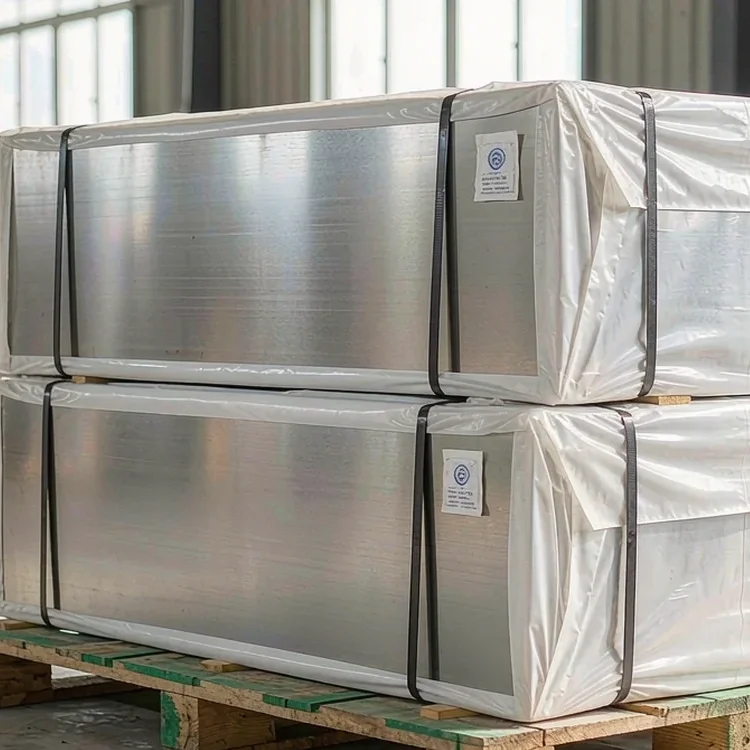
Packing has one job: keep the surface dry and isolated from chlorides and iron for the whole journey. In practice that means a combination of barriers, not a single layer of film.
Surface protection film — PE film with a low-tack adhesive for polished or BA surfaces. Apply on a dry, cool surface; applying over moisture traps it.
VCI (vapour corrosion inhibitor) film or paper — releases a vapour that passivates the surface inside a closed pack. Effective for sea freight when the pack is well sealed and the dosage matches the volume.
Desiccant — calculated by container or pack volume, not by guesswork. Desiccant saturates; a small bag in a 40-foot container does nothing.
Edge and corner protection — plastic or cardboard edge guards prevent strapping damage and impact marks that later become corrosion sites.
Wooden pallets and crates — must be ISPM-15 heat treated for international shipment, and dry. Green timber releases moisture into the pack.
Strapping — plastic strapping with edge protectors. Steel banding in direct contact with stainless is a galvanic and contamination risk.
Ocean transport combines high humidity, chloride-laden air, and a container that heats up and cools down every day. The steel itself has high thermal mass, so it stays cooler than the air at dawn. Moisture condenses on the plate, not on the container walls — the opposite of the “container rain” that affects general cargo.
Three controls make the difference:
Load dry material. Do not pack plates that have just come off a wet process or are still warm from cutting. Let them equalise to ambient temperature.
Seal the pack, not just the container. A well-sealed VCI pack protects the surface even when container humidity swings. Container liners help but cannot compensate for a wet bundle.
Match desiccant to voyage length and season. A 30-day tropical route needs a different specification from a 7-day coastal shipment.
GENCEL ships stainless steel sheet plate with VCI wrapping, calculated desiccant, edge protection and photo-documented packing — so what leaves the mill is what arrives on site.
Tea staining and light surface rust are usually cosmetic and removable. The sequence is:
Wash with clean water and a mild alkaline detergent to remove chlorides and dirt.
Treat localised staining with a stainless-specific cleaner or a dilute nitric-citric passivation gel. Do not use hydrochloric acid or chloride-containing “rust removers” — they make it worse.
Passivate the treated area to rebuild the chromium oxide film, then rinse with deionised water and dry.
Investigate the cause before returning the material to store. If embedded iron is the source, cleaning will not stop it recurring.
Deep pitting is different. If pits are visible and the wall thickness is affected, the plate should be assessed against the minimum design thickness rather than polished. For pressure-retaining parts, that assessment belongs in the quality record.
Storage discipline matters more for 304 than for 316. The molybdenum in 316L raises the pitting resistance equivalent, so a 316L Stainless Steel Sheet Plate tolerates more chloride exposure before staining begins. In coastal warehouses and long sea routes, 316L is often the cheaper choice once rework and claims are counted. Our comparison of 316 and 304 stainless steel explains the trade-off in more detail.
The same logic applies downstream: a plate that arrives clean but is installed with contaminated tools will corrode in service. Our guide to preventing industrial pipeline leakage and protecting valve fittings covers the installation side of the same problem.
Corrosion during storage and transport is a process failure, not a material failure. Dry storage above the floor, air movement, separation from carbon steel and chemicals, and a properly engineered pack will prevent almost all of it. The cost of VCI film, desiccant and edge protection is trivial next to a rejected container or a week of polishing on site.
Put the requirements in writing: storage conditions, packing specification, desiccant quantity, and the inspection record with photos at loading. Then verify on arrival before signing. Suppliers who document packing are also the ones who tend to control the rest of their process — a point worth weighing when you source stainless steel sheet and plate.
Tell us the route, the season and the end use. We will propose film, VCI, desiccant and crating that match the voyage — and send loading photos before the container is sealed.
Can 304 stainless steel sheet rust in storage?
Yes. 304 resists atmospheric corrosion well, but chlorides from sea air, salt, cleaning chemicals or contaminated tools will cause surface rust and tea staining. It is not a material defect; it is a sign that the passive film was broken and could not re-form.
How long can stainless steel sheet be stored outdoors?
Not long, and never unprotected. UV degrades PE film within months, water collects between sheets, and chlorides accumulate. Treat outdoor storage as a short-term measure with a proper cover, ventilation and a defined inspection interval.
Is it safe to cover stainless steel with a tarpaulin?
Usually not. A tarpaulin traps moisture and creates a condensing environment. If you must cover, use a breathable cover with air gaps at the bottom, or better, move the material under a roof.
What causes brown stains that look like rust on new stainless steel?
Almost always embedded iron from carbon steel contact, grinding sparks or contaminated tools, or tea staining from surface chlorides. Both are surface phenomena and can be removed and passivated. Deep pitting is a different matter and needs thickness assessment.
Does VCI film really prevent corrosion during sea freight?
It works when the pack is properly sealed, the surface is dry and clean, and the dosage is matched to the enclosed volume. VCI applied to a wet or contaminated surface will not help — it protects clean metal, it does not clean dirty metal.
Should I specify pickled and passivated sheet for export?
For long sea routes and coastal destinations it is a sensible default. A properly pickled and passivated Stainless Steel Sheet Plate starts with a uniform, fully formed passive film, which gives more tolerance to the humidity cycles of the voyage.



STAINLESS STEEL&GENCEL;
Privacy Policy | SiteMap
Copyright GENCEL STAINLESS STEEL CO.,LIMITED
 Optimized by Seraphinite Accelerator