- Whatsapp: 8613738300923
- Email: [email protected]


Specifying a Stainless Steel Sheet Plate by grade alone is one of the most common reasons a fabricated part underperforms. Two sheets cut from the same 304L coil, one at 1.2 mm and one at 3.0 mm, will behave completely differently in a tank wall, a conveyor chute or a flange stiffener — not because the chemistry changed, but because thickness controls stiffness, load capacity, corrosion reserve and how the material behaves under the torch.
This guide explains what thickness actually does to strength and durability, where the practical limits sit, and how to choose a thickness you can defend in a specification. It is written for buyers, fabricators and project engineers who need to justify a wall thickness rather than guess it.

Three different properties respond to thickness in three different ways, and mixing them up leads to over- or under-design.
Stiffness (deflection) scales with t³. Double the thickness of a flat panel and it becomes roughly eight times harder to deflect. This is why a 2 mm cover plate can look “strong enough” on paper and still oil-can in service.
Bending and membrane load capacity scale with t². A section twice as thick resists about four times the bending moment at the same stress level. Pressure retention in a flat or cylindrical wall follows the same logic.
Corrosion and erosion reserve scale linearly with t. Thickness is consumed slowly by uniform corrosion, and much faster by erosion-corrosion, cavitation or mechanical wear at seals and gasket faces.
Grade still matters. A 3 mm 304L Stainless Steel Sheet Plate and a 3 mm 316L sheet have the same stiffness, but the 316L version with 2–3% molybdenum keeps its passive film far longer in chlorides. Thickness fixes the mechanics; grade fixes the chemistry. For a side-by-side of the two most common austenitic options, see our guide on whether 316 or 304 stainless steel is the better choice.

Durability in stainless steel is usually a story about surfaces, and thickness buys you time and tolerance for surface damage.
Stainless steel does not corrode at a predictable “millimetres per year” rate the way carbon steel does, but it still loses wall at welds, gasket faces, crevices and high-velocity bends. A thicker Stainless Steel Sheet Plate tolerates several years of light pitting or erosion before the wall falls below the minimum design thickness. Thin gauges below 1 mm leave almost no margin: one aggressive cleaning cycle with a chlorinated sanitiser can be enough to start a through-wall pit.
Thin sheet in vibrating service — screens, chutes, fan housings, pump bases — fails by fatigue cracking at welds long before it fails by yield. Increasing thickness reduces the stress range at the toe of the weld, which is often cheaper than adding stiffeners and re-qualifying a weld procedure.
Below roughly 1.0 mm, heat input during TIG or laser welding becomes critical. Thin Stainless Steel Sheet Plate distorts, sugar-plums and burns through unless the fit-up is excellent and the procedure is qualified. From 2 mm upward, welding becomes forgiving and the heat-affected zone is easier to control.
Every mill delivers within a permitted tolerance band. For hot rolled plate to ASTM A480 the permitted minus tolerance on a 3.0 mm sheet can be around 0.3 mm; cold rolled sheet to EN 10088-2 is usually tighter, particularly in the “special” tolerance class. If you design a 2.0 mm wall with zero margin and receive 1.75 mm material, the whole calculation changes.
| Nominal thickness | Typical use | Watch out for |
| 0.5–1.0 mm | Cladding, panels, ducts, splash guards | Oil-canning, weld burn-through, no corrosion margin |
| 1.2–3.0 mm | Tanks, hoppers, food equipment, machine guards | Deflection between stiffeners, gasket face flatness |
| 4.0–6.0 mm | Small pressure vessels, flange blanks, wear plates | Cut edge squareness, bending force, preheating rules |
| 8–20 mm and above | Heavy chemical equipment, tube sheets, structural nodes | Through-thickness properties, UT inspection, delivery lead time |
Always state the standard and the tolerance class on the purchase order, not only “2 mm”. A supplier quoting only nominal thickness is quoting a range, and the range is where failures hide.
Tell us the application, medium and design pressure — GENCEL will confirm the stainless steel sheet plate thickness, finish and standard before you commit to a PO.
These are the ranges GENCEL sees most often in confirmed orders. They are starting points, not a substitute for a design calculation.
Chemical and petrochemical tanks: 3–6 mm shell plate, thicker at the bottom course and around nozzles; 316L or duplex where chlorides are present.
Food, dairy and beverage equipment: 1.5–3 mm, 2B or BA finish, with smooth welds and no crevices. Thickness is chosen for cleanability and stiffness more than pressure.
Ducting and cladding: 0.5–1.2 mm, usually 304 with a No.4 or 2B finish; stiffness comes from folding, not from wall thickness.
Flange blanks and wear plates: 6 mm and up, where the plate is machined or drilled and needs room for bolt circles and gasket faces.
Structural supports in wet environments: 4–8 mm, sized for deflection limits rather than yield.
If the plate is being joined to pipe or fittings, thickness compatibility matters as much as the number itself. A 3 mm Stainless Steel Sheet Plate welded to a Schedule 10 pipe creates a thickness mismatch that concentrates stress and complicates the weld procedure. Our stainless steel sheet range is stocked in thickness steps that match common pipe schedules for exactly this reason.
The commercial boundary is usually 6 mm: below that, material is rolled in coil and cut to sheet; above it, it is rolled as plate. The practical consequences are:
Sheet is flatter and has better surface consistency, so it is preferred for visible and hygienic surfaces.
Plate carries more residual stress from rolling and may need stress relief before machining.
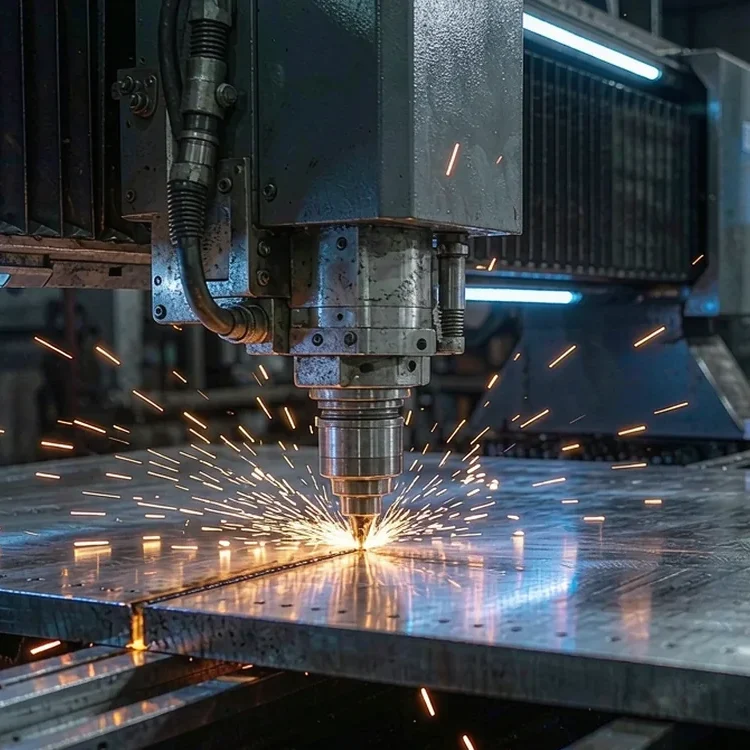
Cutting method changes: sheet is normally laser or plasma cut, plate above 12 mm often needs waterjet or heavy plasma to hold the edge quality.
Bending force rises steeply — a 6 mm plate needs roughly four times the tonnage of a 3 mm sheet on the same bend length.
Designing to nominal thickness. Use the minimum permitted thickness plus a corrosion allowance, not the catalogue number.
Ignoring deflection. A panel that passes a stress check can still fail a stiffness check; calculate deflection between supports first.
Confusing gauge with millimetres. 16 gauge is about 1.5 mm, 18 gauge about 1.2 mm, 20 gauge about 0.9 mm — and the conversion differs between US and imperial standards. Order in millimetres.
Thinning the plate to save cost at the gasket face. Bolted joints need local thickness; a thinner sheet will leak before it yields.
Thickness is the cheapest and most reliable lever you have over the strength and durability of a Stainless Steel Sheet Plate. It sets stiffness at the cube of the number, load capacity at the square, and corrosion reserve in a straight line. Grade decides whether the surface survives the environment; thickness decides whether the part survives the mechanics and the handling.
Before you release a specification, state three things: the nominal thickness in millimetres, the standard and tolerance class, and the minimum thickness you will accept after fabrication. Those three lines prevent most of the arguments that appear at goods-in inspection. If you are also weighing 304 against 316 for the same part, our comparison of 304 and 202 stainless steel sheets explains where the lower-nickel grades stop being a safe substitution.
Send your drawing, medium, temperature and pressure. You will receive a material recommendation with mill certificate, tolerance class and available finishes.
Does a thicker stainless steel sheet plate always mean a stronger part?
It means a stiffer and generally stronger part, but not automatically a better one. Beyond the design requirement, extra thickness adds weight, cost, welding heat input and forming force. It can also increase restraint and residual stress in a welded assembly. Thickness should be the outcome of a calculation, not a safety habit.
Is 1.5 mm stainless steel sheet strong enough for a tank?
For a small atmospheric tank with good support spacing, 1.5 mm can be adequate. For anything above roughly 1 m in height, with agitation, heating or vacuum, it usually is not — deflection and weld distortion take over. Most industrial tanks move to 3 mm or more at the shell.
How much does doubling thickness improve stiffness?
About eight times, because stiffness is proportional to thickness cubed. Load capacity at the same stress rises about four times. That is why a small thickness change often solves a vibration or oil-canning problem that stiffeners would otherwise be needed for.
Does thickness affect corrosion resistance?
Not the corrosion rate itself, which is set by grade, surface finish and environment — but it strongly affects how long the part lasts. A thicker Stainless Steel Sheet Plate tolerates more pitting, erosion and mechanical damage before reaching minimum wall.
What thickness tolerance should I specify?
For cold rolled sheet, ask for EN 10088-2 special tolerances or the tighter ASTM A480 class where flatness and gauge control matter. For hot rolled plate, agree the minus tolerance explicitly in writing. Never accept “nominal” as a delivery condition on a pressure-retaining part.
Can I weld 0.8 mm stainless sheet without distortion?
Yes, with a qualified procedure: low heat input, tight fit-up, backing gas, and usually laser or pulsed TIG. It is a specialist process, and the reject rate is higher than at 2 mm. If distortion is unacceptable, increase thickness or change the joint design.



STAINLESS STEEL&GENCEL;
Privacy Policy | SiteMap
Copyright GENCEL STAINLESS STEEL CO.,LIMITED
 Optimized by Seraphinite Accelerator