- Whatsapp: 8613738300923
- Email: [email protected]


A sanitary stainless steel centrifugal pump is an essential piece of equipment for transferring liquids in industries where hygiene, product quality, and reliable fluid handling are critical. It is widely used in food and beverage processing, dairy production, pharmaceutical manufacturing, biotechnology, cosmetics, and other applications that require hygienic equipment design.
Compared with standard industrial pumps, sanitary centrifugal pumps are designed with smooth product-contact surfaces, corrosion-resistant materials, and structures that support effective cleaning. These features help reduce the risk of product contamination and make the pumps suitable for hygienic production environments.
Understanding how a sanitary stainless steel centrifugal pump works, its main components, and its key selection factors can help manufacturers and purchasing teams choose suitable equipment for their processing systems.
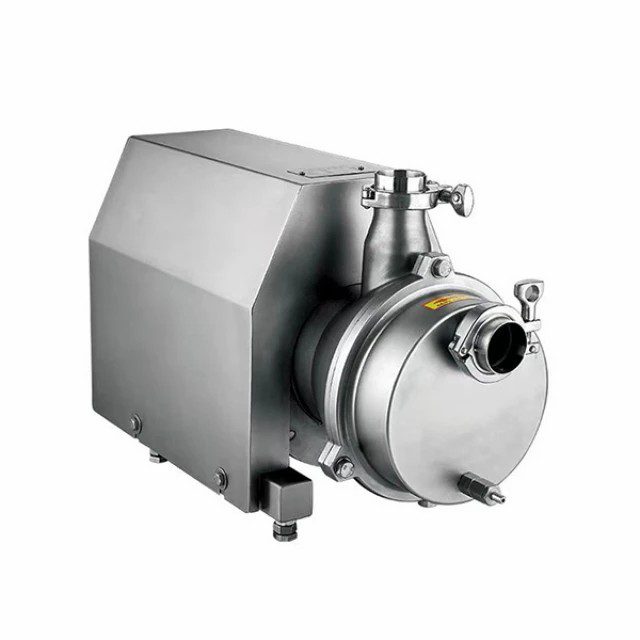
A sanitary stainless steel centrifugal pump is a type of centrifugal pump designed to transfer liquids while meeting the hygiene requirements of sanitary processing applications. It uses a rotating impeller to convert mechanical energy into fluid movement, allowing liquids to flow through pipelines and processing equipment.
The pump’s wetted parts are commonly made from stainless steel, such as AISI 304 or 316L, depending on the fluid, cleaning chemicals, operating temperature, and corrosion requirements. Surface finish, seal materials, drainability, and cleanability are also important design considerations.
Sanitary centrifugal pumps are commonly used to transfer low- to medium-viscosity liquids, including milk, juice, water, liquid ingredients, and certain pharmaceutical or cosmetic formulations. Their suitability depends on the liquid’s properties and the pump’s performance specifications.
A sanitary design does not automatically guarantee compliance with every hygiene standard. Buyers should verify material certificates, surface finish requirements, applicable certifications, and cleaning compatibility according to their specific industry and process.
A sanitary centrifugal pump operates by using rotational energy to move liquid. An electric motor drives the impeller, which accelerates the liquid and creates the pressure needed to move it through the discharge pipeline.
The process generally involves four steps.
1. Liquid Enters the Pump
Liquid enters through the suction inlet and flows toward the center of the impeller, known as the impeller eye. Proper inlet conditions help ensure a stable liquid supply and reduce the risk of cavitation.
The suction pipe arrangement, liquid temperature, inlet pressure, and available suction head can all affect pump performance.
2. The Impeller Rotates
The motor rotates the impeller at a specified speed. As the impeller blades move, they transfer energy to the liquid and accelerate it outward through the impeller passages.
This rotating action is the core mechanism that distinguishes centrifugal pumps from many positive displacement pumps.
3. Fluid Velocity Is Converted into Pressure
After leaving the impeller, the liquid enters the pump casing. The casing and its flow passages help convert part of the liquid’s velocity into pressure energy.
The resulting pressure enables the liquid to overcome resistance from the pipeline, valves, filters, heat exchangers, and other equipment in the process system.
4. Liquid Flows Through the Discharge Outlet
The pressurized liquid exits through the discharge connection and continues to the next stage of the production process.
During operation, the pump’s actual flow rate and discharge pressure depend on factors such as impeller diameter, rotational speed, liquid properties, system resistance, and the pump’s performance curve.
Understanding the main components helps buyers evaluate pump construction, maintenance requirements, and suitability for hygienic applications.
The impeller transfers rotational energy from the motor to the liquid. Its diameter, blade geometry, and rotational speed influence flow rate, head, and efficiency. Impeller design should match the required operating conditions and the characteristics of the liquid being transferred.
The pump casing surrounds the impeller and directs liquid toward the discharge outlet. In sanitary applications, the internal flow path should be designed to support cleanability and minimize areas where product residue could accumulate.
Wetted parts are the components that come into contact with the process liquid. These may include the impeller, casing, and selected internal fittings. Stainless steel provides corrosion resistance and a durable surface, but the appropriate grade depends on the liquid chemistry and cleaning environment.
The mechanical seal helps prevent liquid from leaking along the rotating shaft. Seal face materials and elastomers must be compatible with the process liquid, temperature, pressure, and cleaning agents.
For demanding hygienic applications, seal accessibility, replacement requirements, and the risk of product accumulation around the seal area should also be considered.
The motor supplies the power needed to rotate the impeller, while the shaft transfers torque to the rotating assembly. Motor power and speed should be matched to the pump’s required operating point. Depending on the installation, the motor may also need a suitable enclosure and protection rating for the production environment.
Sanitary connections allow the pump to be integrated into hygienic piping systems. Common connection options may include clamp, threaded, or welded configurations, depending on the pump design and regional requirements. Gaskets must be compatible with the liquid and cleaning process.
1. Hygienic Design
Sanitary pumps are designed to reduce contamination risks through appropriate product-contact materials, smooth internal surfaces, and cleanable flow paths. These characteristics are particularly important when handling food, beverages, dairy products, and pharmaceutical ingredients.
Actual hygienic performance depends on the complete design, installation, and cleaning procedure rather than stainless steel construction alone.
2. Corrosion Resistance
Stainless steel can provide strong resistance to corrosion in many processing environments. Grade 304 may be suitable for a range of general applications, while 316L is often selected when greater resistance to certain corrosive media is required.
The correct choice should be based on the process liquid, chloride concentration, cleaning chemicals, temperature, and other operating conditions.
3. Efficient Liquid Transfer
Centrifugal pumps can provide continuous flow and are suitable for many liquid-transfer operations. When selected and operated near an appropriate point on the performance curve, they can deliver reliable performance with reasonable energy consumption.
However, efficiency varies with pump design, system requirements, liquid properties, and operating conditions.
4. Easy Integration into Processing Systems
Sanitary centrifugal pumps are commonly available in configurations suitable for connection to stainless steel process piping. Their compact designs can make them practical for production lines, storage tank transfer, mixing systems, and other liquid-handling processes.
5. Maintenance and Serviceability
Routine inspection of mechanical seals, bearings, gaskets, and motor components can help reduce unexpected downtime. A pump with accessible components and readily available replacement parts can also simplify maintenance planning.
Sanitary centrifugal pumps serve a range of industries that require controlled and hygienic liquid transfer.
| Industry | Typical Applications |
| Food and beverage | Juice, liquid ingredients, beverages, and process water |
| Dairy processing | Milk, whey, and other suitable dairy liquids |
| Pharmaceutical manufacturing | Transfer of compatible process liquids and selected ingredients |
| Biotechnology | Liquid transfer in suitable hygienic process systems |
| Cosmetics and personal care | Transfer of compatible liquid formulations |
| Chemical and specialty processing | Transfer of compatible liquids where sanitary construction is required |
Not every centrifugal pump is suitable for every product. Highly viscous fluids, shear-sensitive products, liquids containing large solid particles, or applications requiring precise metering may need a different pump design. Buyers should confirm the pump’s compatibility with the product and process.
Although both types use an impeller to move liquid, their design priorities differ.
| Feature | Sanitary Centrifugal Pump | Standard Industrial Centrifugal Pump |
| Main priority | Hygienic liquid handling | General fluid transfer |
| Product-contact materials | Selected for hygiene and corrosion resistance | Selected according to general service requirements |
| Internal surface finish | May have specified hygienic finish requirements | Finish requirements vary by application |
| Cleanability | Designed to support hygienic cleaning | May not be designed for sanitary cleaning |
| Typical applications | Food, beverage, dairy, pharmaceutical, and similar processes | Water supply, utilities, general industrial processes |
| Documentation | May require material traceability and hygiene-related documentation | Depends on the application and industry |
The distinction is not simply the stainless steel material. A standard stainless steel centrifugal pump may still lack the internal geometry, surface finish, seals, documentation, or cleanability required for a sanitary process.
Selecting a suitable pump requires evaluating the process requirements as a whole.
1. Determine the Required Flow Rate and Head
Flow rate describes how much liquid the pump must transfer over a given period, while head represents the energy imparted to the liquid expressed as an equivalent height of fluid.
Buyers should calculate the required flow and total dynamic head, including elevation differences and friction losses in the piping system. The pump should operate within an appropriate range on its performance curve rather than being selected by motor power alone.
2. Select the Appropriate Stainless Steel Grade
AISI 304 and 316L are common options for sanitary pump construction. The choice depends on the chemical composition of the liquid, corrosion exposure, cleaning agents, temperature, and required service life.
For applications involving aggressive chemicals or high chloride concentrations, additional material compatibility review may be necessary.
3. Check Liquid Properties
Viscosity, temperature, density, solids content, and sensitivity to shear can influence pump performance. Standard centrifugal pumps are generally most suitable for relatively low-viscosity liquids. More viscous or shear-sensitive products may require a specialized impeller design or an alternative pump type.
4. Verify Cleaning Requirements
Confirm whether the system uses clean-in-place (CIP), clean-out-of-place (COP), or manual cleaning. The pump’s internal geometry, seal design, drainage characteristics, and compatibility with cleaning chemicals should match the cleaning procedure.
CIP capability should be verified for the specific pump configuration and validated process; it should not be assumed from the sanitary label alone.
5. Confirm Connections and Installation Conditions
Check inlet and outlet sizes, connection type, installation space, pipe layout, electrical supply, and motor protection requirements. Proper alignment and appropriate suction piping can help reduce vibration, noise, and cavitation risk.
6. Evaluate the Manufacturer
A reliable manufacturer should be able to provide relevant technical documentation, performance curves, material information, seal options, dimensional drawings, and maintenance guidance. For OEM projects, confirm whether the supplier can customize connections, motor configurations, or other specifications while maintaining the required hygienic design.
Regular maintenance helps preserve pump performance and reduce the risk of unplanned downtime.
Inspect mechanical seals and gaskets: Look for leakage, wear, cracking, or chemical degradation.
Monitor noise and vibration: Unusual changes may indicate cavitation, misalignment, bearing wear, or an operating point outside the recommended range.
Keep suction conditions stable: Avoid blocked strainers, undersized suction pipes, and conditions that may cause insufficient inlet pressure.
Follow the correct cleaning procedure: Use compatible cleaning agents, temperatures, concentrations, and procedures specified for the pump and process.
Check operating performance: Compare actual flow, pressure, and power consumption with expected values to identify changes early.
Maintenance intervals should be based on operating hours, process conditions, manufacturer recommendations, and the consequences of equipment failure.
A sanitary stainless steel centrifugal pump combines centrifugal pumping technology with design features intended to support hygienic liquid handling. Its impeller creates fluid movement, the casing helps convert velocity into pressure, and the discharge connection delivers liquid to the next stage of the process.
For food and beverage manufacturers, dairy processors, pharmaceutical companies, and other hygienic production facilities, choosing the right pump involves more than selecting a stainless steel model. Flow rate, head, material compatibility, seal design, cleanability, connection type, and maintenance requirements all influence long-term performance.
By working with an experienced sanitary pump manufacturer and providing clear process specifications, buyers can identify equipment that meets their operational requirements and supports reliable, hygienic production.
1. What is a sanitary stainless steel centrifugal pump?
A sanitary stainless steel centrifugal pump is designed to transfer liquids in hygienic processing environments. It uses a rotating impeller to move liquid and typically features corrosion-resistant stainless steel wetted parts, cleanable internal surfaces, and hygienic sealing components.
2. How does a sanitary stainless steel centrifugal pump work?
The pump uses a motor to rotate an impeller, which accelerates liquid outward from the impeller’s center. The pump casing helps convert the liquid’s velocity into pressure, allowing the liquid to flow through the discharge pipeline.
3. What industries use sanitary stainless steel centrifugal pumps?
These pumps are commonly used in food and beverage processing, dairy production, pharmaceutical manufacturing, biotechnology, cosmetics, and other industries that require hygienic liquid transfer.
4. What is the difference between a sanitary centrifugal pump and a standard centrifugal pump?
A sanitary centrifugal pump is designed to support hygienic processing through features such as cleanable flow paths, suitable product-contact materials, and compatible seals. A standard centrifugal pump may prioritize general fluid transfer and may not meet the cleaning or hygiene requirements of sanitary applications.
5. Should I choose 304 or 316L stainless steel for a sanitary centrifugal pump?
Grade 304 is suitable for many general applications, while 316L is often preferred when greater resistance to certain corrosive liquids and cleaning chemicals is required. The final choice depends on the process liquid, temperature, chloride concentration, and cleaning conditions.

STAINLESS STEEL&GENCEL;
Privacy Policy | SiteMap
Copyright GENCEL STAINLESS STEEL CO.,LIMITED
 Optimized by Seraphinite Accelerator