- Whatsapp: 8613738300923
- Email: [email protected]


Tank inspection is an important part of industrial production, particularly in food and beverage processing, pharmaceutical manufacturing, chemical production, and other industries involving liquid storage and processing. Operators need to monitor liquid levels, observe internal conditions, and identify potential abnormalities without unnecessarily interrupting production.
However, inspecting the interior of an enclosed tank can be challenging, especially when lighting conditions are poor or the stored medium is difficult to observe. Traditional sight glasses provide a viewing window, but visibility may be limited when inspecting dark tanks, opaque liquids, or poorly illuminated process equipment.
A sight glass with light addresses this problem by combining a transparent viewing window with an integrated illumination system. It provides better visibility of the tank interior, allowing operators to observe process conditions more conveniently and efficiently.
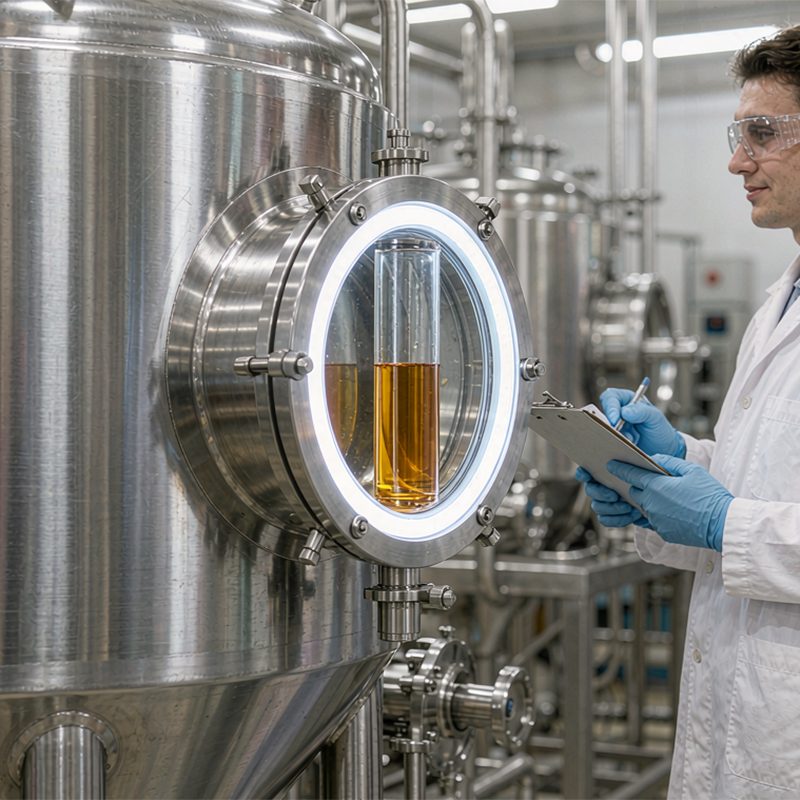
A sight glass with light is an industrial observation device that combines a sight glass window with an integrated lighting component. It is installed on tanks, vessels, pipelines, or processing equipment to provide a clear view of internal conditions.
The sight glass allows operators to observe the process medium, while the lighting system illuminates the viewing area to improve visibility.
Depending on the product design, a sight glass with light may include:
Transparent Viewing Window: Usually manufactured from suitable glass materials to provide visibility into the tank.
Lighting Unit: Provides illumination for observing internal conditions.
Housing and Mounting Structure: Secures the viewing assembly to the tank or equipment.
Sealing Components: Help maintain a reliable connection and prevent leakage.
Electrical Connection: Supplies power to the lighting system.
Some models also incorporate protective covers, specialized mounting arrangements, and lighting configurations designed for specific industrial environments.
A sight glass with light offers several practical advantages over conventional observation windows, particularly when operators need to inspect tank interiors frequently.
Improves Visibility Inside Enclosed Tanks
One of the biggest challenges in tank inspection is insufficient internal lighting. Even when a tank has a transparent viewing window, operators may struggle to observe its contents if the interior is dark.
An integrated lighting system illuminates the observation area, making it easier to identify liquid conditions, material movement, and visible changes inside the tank.
This is especially useful for large vessels, deep tanks, and equipment installed in areas with limited natural light.
Efficiency benefit: Operators can observe internal conditions more clearly without relying entirely on external flashlights or additional lighting equipment.
Reduces Inspection Time
Traditional tank inspection may require operators to reposition external lights, adjust their viewing angles, or repeat observations to obtain a clear view.
A sight glass with light provides a more convenient and consistent illumination source. Operators can quickly inspect the tank interior through the viewing window.
This reduces unnecessary inspection steps and helps maintenance and production teams complete routine checks more efficiently.
Efficiency benefit: Faster visual checks can reduce inspection time and improve the efficiency of daily production operations.
Helps Identify Abnormal Process Conditions
Visual monitoring is important for identifying unusual conditions during industrial processing.
Depending on the visibility of the medium, operators may use a sight glass with light to observe:
Unexpected liquid level changes.
Foam accumulation.
Sediment or particle buildup.
Abnormal color changes.
Material movement and mixing conditions.
Visible contamination or foreign objects.
The additional illumination makes these observations easier, particularly when the tank interior is naturally dark.
Efficiency benefit: Earlier identification of visible abnormalities allows operators to investigate potential problems before they develop into more serious production issues.
Supports Continuous Process Monitoring
In many industrial environments, tanks are used for mixing, heating, cooling, storage, and chemical reactions. Operators need to understand how materials behave throughout different production stages.
A sight glass with light provides a convenient observation point that helps operators monitor visible process changes without opening the tank.
For example, during mixing operations, workers may observe liquid movement and foam formation. In storage applications, they may check the appearance and condition of the stored material.
Efficiency benefit: Improved visibility supports more convenient process monitoring and reduces the need for unnecessary manual inspection activities.
Reduces the Need for External Lighting Equipment
Without integrated illumination, operators may need portable lamps, handheld flashlights, or temporary lighting arrangements to inspect tank interiors.
These additional devices can create inconvenience, especially when observation points are located in narrow spaces or difficult-to-access areas.
A sight glass with light integrates illumination into the observation assembly, making the inspection process more straightforward.
Efficiency benefit: Fewer external lighting arrangements can simplify inspection preparation and reduce equipment handling.
Improves Operator Convenience and Workplace Safety
Opening an industrial tank for internal inspection may introduce additional risks, including exposure to process materials, pressure release, contamination, and confined-space hazards.
A properly designed sight glass with light allows operators to conduct external visual observations without opening the tank.
It can therefore reduce the frequency of unnecessary tank access and support safer inspection procedures.
However, a sight glass is not a substitute for required internal inspections, isolation procedures, or confined-space safety controls.
Efficiency benefit: Operators can complete many routine visual checks from outside the vessel, reducing unnecessary intervention in the production system.
Understanding the main components helps equipment manufacturers and purchasing professionals evaluate product specifications.
Sight Glass Window
The viewing window is the primary observation component. It should provide suitable transparency, mechanical strength, and resistance to the operating environment.
Depending on the application, common materials include:
Borosilicate Glass: Offers good thermal shock resistance and chemical durability in many industrial applications.
Tempered Glass: Provides increased mechanical strength compared with ordinary glass, depending on its design and application.
Quartz Glass: Can be used in specialized applications requiring particular optical or temperature-related properties.
The appropriate material depends on operating pressure, temperature, chemical compatibility, and applicable design requirements.
Lighting System
The lighting system illuminates the tank interior to improve observation quality.
LED lighting is commonly used because it offers energy efficiency, relatively long service life, and compact installation options.
Important lighting considerations include brightness, light distribution, heat generation, electrical protection, and compatibility with the installation environment.
Housing and Mounting Structure
The housing secures the sight glass and lighting components to the tank or vessel.
Stainless steel is commonly selected for industrial applications because of its corrosion resistance and suitability for many processing environments.
The mounting structure must also match the tank connection dimensions and relevant pressure and temperature requirements.
Sealing Components
Gaskets and other sealing components help prevent leakage around the sight glass assembly.
Common gasket materials include silicone, EPDM, PTFE, and other application-specific materials.
Selection should consider the process medium, operating temperature, pressure, and applicable hygiene requirements.
Sight glasses with light are used in various industries where internal visual inspection is important.
Food and Beverage Processing
Food and beverage manufacturers use tanks for liquid storage, mixing, fermentation, and ingredient preparation.
Sight glasses with light allow operators to observe visible process conditions, such as liquid movement, foam formation, and material appearance.
In hygienic processing environments, product design should support appropriate cleaning procedures and meet relevant sanitary requirements.
Pharmaceutical Manufacturing
Pharmaceutical production requires controlled processing conditions and reliable equipment inspection.
Sight glasses with light can help operators observe liquid conditions and visible process changes inside storage and processing vessels.
Materials, surface finishes, sealing structures, and cleaning compatibility should be evaluated according to the specific pharmaceutical application.
Chemical Processing
Chemical plants use tanks and vessels to store, mix, and process various chemical substances.
An illuminated sight glass provides a convenient observation point for monitoring visible material conditions.
The window material, housing, seals, and electrical components must be compatible with the chemicals, pressure, temperature, and hazardous-area requirements of the installation.
Water Treatment
Water treatment facilities use storage and processing tanks for different stages of water handling.
Sight glasses with light can help operators observe liquid appearance, sediment accumulation, and other visible changes inside suitable vessels.
They are particularly useful where tank interiors have limited lighting.
Cosmetics and Personal Care Manufacturing
Cosmetics manufacturers often use tanks for mixing creams, lotions, gels, and liquid formulations.
An illuminated sight glass can help operators observe visible material movement, mixing conditions, and product appearance during production.
Selecting a suitable product requires evaluating both observation requirements and operating conditions.
Determine the Tank Operating Conditions
Before selecting a sight glass with light, identify the tank’s operating pressure, temperature, process medium, and installation environment.
These factors influence the required glass material, housing design, sealing structure, and lighting configuration.
Select the Appropriate Glass Material
Different glass materials offer different mechanical, thermal, and chemical properties.
For example, borosilicate glass is commonly used in industrial applications requiring good thermal shock resistance. Quartz glass may be more suitable for certain specialized high-temperature applications.
The final selection should be based on verified product specifications and actual operating conditions.
Evaluate Lighting Performance
Lighting performance directly affects observation quality.
Consider the light source, brightness, illumination angle, power consumption, heat generation, and service life.
LED lighting is often a practical choice for industrial observation equipment, but the exact configuration should match the tank dimensions and inspection requirements.
Check Pressure and Temperature Ratings
The sight glass assembly must be suitable for the tank’s operating conditions.
Verify the pressure and temperature ratings of the complete assembly, including the glass, housing, fasteners, and sealing components.
Do not evaluate pressure capability based on the glass material alone.
Consider Material and Chemical Compatibility
For chemical, pharmaceutical, and food processing applications, all product-contact or potentially exposed materials should be compatible with the process medium and cleaning chemicals.
Stainless steel grades such as 304 and 316 are commonly used for industrial housings, depending on corrosion requirements.
Confirm Electrical Protection Requirements
Because a sight glass with light includes electrical components, buyers should evaluate the electrical protection requirements of the installation.
Consider voltage, wiring connections, ingress protection, grounding, and any hazardous-area certification requirements.
For potentially explosive atmospheres, the complete lighting assembly must have appropriate certification for the specific hazardous-area classification.
Evaluate Installation and Maintenance Requirements
Check the mounting dimensions, connection type, available installation space, and accessibility of electrical components.
A design that allows convenient cleaning, lighting replacement, and routine inspection can reduce long-term maintenance effort.
Both products provide visual access to tank interiors, but their observation capabilities differ.
| Comparison Factor | Traditional Sight Glass | Sight Glass with Light |
| Internal illumination | Depends on external lighting | Integrated lighting |
| Visibility in dark tanks | Often limited | Improved |
| Inspection convenience | May require additional lighting | More convenient |
| Equipment configuration | Simpler structure | Includes electrical components |
| Maintenance | Mainly glass and sealing components | Includes glass, seals, and lighting |
| Initial cost | Generally lower | Generally higher |
A traditional sight glass may be sufficient for tanks with adequate ambient lighting. However, an illuminated design can provide greater inspection convenience when internal visibility is limited.
A sight glass with light improves tank inspection efficiency by combining visual access with integrated illumination. It helps operators observe internal conditions more clearly, reduces the need for external lighting equipment, supports routine process monitoring, and makes many visual inspection tasks more convenient.
For food and beverage, pharmaceutical, chemical, water treatment, and cosmetics manufacturers, choosing the right illuminated sight glass requires careful consideration of glass materials, lighting performance, pressure and temperature ratings, sealing components, and electrical protection.
Working with an experienced sight glass manufacturer can help ensure that the product configuration matches the actual tank design and operating environment. A properly selected sight glass with light can improve inspection convenience, support production monitoring, and contribute to more efficient industrial operations.
1.What is a sight glass with light used for?
A sight glass with light is used to observe the internal conditions of industrial tanks, vessels, and processing equipment. Its integrated lighting system improves visibility, allowing operators to monitor liquid levels, material movement, foam formation, and other visible process conditions.
2.How does a sight glass with light improve inspection efficiency?
It provides direct illumination inside the tank, making internal conditions easier to observe. This reduces the need for external lighting equipment, simplifies routine visual inspections, and helps operators identify visible abnormalities more quickly.
3.What is the difference between a traditional sight glass and a sight glass with light?
A traditional sight glass relies on ambient or external lighting to illuminate the viewing area. A sight glass with light incorporates an additional lighting system, providing better visibility when inspecting dark tanks or poorly illuminated environments.
4.What materials are commonly used for sight glasses with light?
Common viewing window materials include borosilicate glass, tempered glass, and quartz glass. Housing components are often manufactured from 304 or 316 stainless steel, depending on corrosion resistance and application requirements.
5.Why is LED lighting commonly used in sight glasses?
LED lighting offers energy efficiency, compact dimensions, relatively long service life, and low heat generation. These characteristics make it suitable for many industrial tank inspection applications.

STAINLESS STEEL&GENCEL;
Privacy Policy | SiteMap
Copyright GENCEL STAINLESS STEEL CO.,LIMITED
 Optimized by Seraphinite Accelerator