- Whatsapp: 8613738300923
- Email: [email protected]


High pressure clamps play an important role in industrial piping systems by providing secure connections between pipes, hoses, fittings, and other components operating under elevated pressure. They are widely used in industries such as chemical processing, oil and gas, food and beverage production, pharmaceutical manufacturing, water treatment, and industrial equipment manufacturing.
Different applications require different clamp designs depending on operating pressure, pipe dimensions, connection structures, materials, and working environments. Selecting an unsuitable clamp may result in connection leakage, vibration-related loosening, equipment damage, or unexpected maintenance costs.
Understanding the different types of high pressure clamps helps engineers, equipment manufacturers, and purchasing professionals choose suitable connection solutions for their systems. This article explores common high pressure clamp types, their characteristics, industrial applications, and key selection considerations.
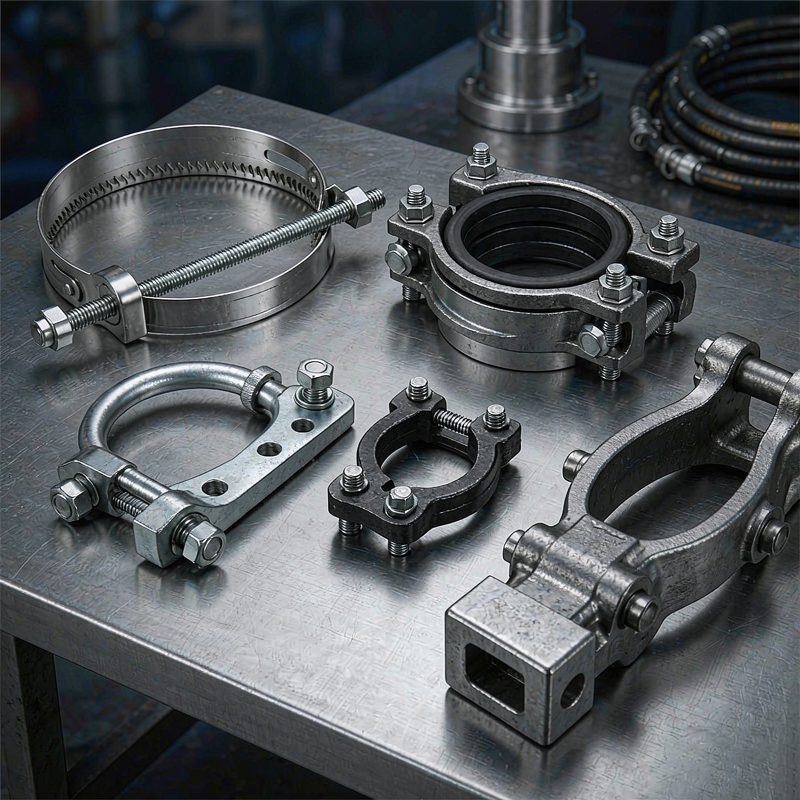
A high pressure clamp is a mechanical fastening component designed to secure pipe connections, hose assemblies, or other industrial components exposed to elevated internal or external pressure.
Unlike conventional clamps intended for light-duty fastening, high pressure clamps are typically manufactured with stronger structural materials, reinforced fastening mechanisms, and more reliable locking designs.
Depending on the application, a high pressure clamp may use bolts, threaded fasteners, locking mechanisms, or specialized connection structures to maintain a stable connection.
Common materials include stainless steel, carbon steel, and alloy steel. Stainless steel clamps are particularly suitable for applications requiring corrosion resistance, durability, and hygienic performance.
High pressure clamps are available in several designs to accommodate different industrial connection requirements. The following are some commonly used types.
High Pressure Bolt Clamps
High pressure bolt clamps use threaded bolts and nuts to generate clamping force around pipes, hoses, or connected components. Their fastening structure allows users to adjust tightening force according to the application requirements.
These clamps are commonly used in industrial piping systems, hydraulic equipment, machinery, and heavy-duty hose connections.
Key characteristics:
Strong mechanical fastening through bolted connections.
Adjustable tightening force.
Suitable for demanding industrial environments.
Available in different sizes and material grades.
Bolt clamps are a practical option when secure mechanical fastening and convenient installation are important.
High Pressure Pipe Clamps
High pressure pipe clamps are designed to support and secure pipes in industrial piping installations. Depending on their construction, they can help maintain pipe alignment, reduce movement, and control vibration.
They are commonly used in hydraulic systems, chemical processing facilities, power plants, and industrial fluid transportation networks.
Key characteristics:
Designed for different pipe diameters.
Available in single-piece and multi-piece configurations.
Can incorporate rubber or polymer inserts for vibration reduction.
Help improve pipe stability and installation reliability.
When selecting pipe clamps, engineers should consider pipe diameter, operating temperature, vibration levels, and mounting requirements.
High Pressure Hose Clamps
High pressure hose clamps are used to secure flexible hoses to fittings, connectors, and other connection components. Their primary function is to maintain a stable connection and reduce the risk of hose separation or leakage.
These clamps are frequently found in hydraulic systems, industrial machinery, automotive equipment, and fluid transfer applications.
Key characteristics:
Designed for specific hose and fitting combinations.
Available with reinforced fastening structures.
Can accommodate different hose diameters.
Suitable for various industrial fluid transfer applications.
It is important to distinguish between ordinary hose clamps and pressure-rated hose retention systems. A standard hose clamp should not automatically be considered suitable for high-pressure hydraulic or fluid service.
High Pressure Sanitary Clamps
High pressure sanitary clamps are designed for hygienic piping connections in industries where cleanliness and contamination control are essential.
They are commonly used in food and beverage processing, pharmaceutical production, biotechnology, and cosmetics manufacturing.
These clamps are frequently used with sanitary ferrules and compatible gaskets to create detachable connections.
Key characteristics:
Commonly manufactured from 304 or 316L stainless steel.
Smooth surfaces that support hygienic cleaning requirements.
Quick assembly and disassembly.
Compatible with appropriate sanitary fittings and gaskets.
The clamp, gasket, and ferrule assembly must be selected according to the required pressure rating and applicable sanitary standards.
High Pressure Double Bolt Clamps
Double bolt clamps use two fastening points to distribute clamping force across the connection. This design can provide more balanced tightening compared with some single-bolt configurations.
They are commonly used in industrial hose assemblies, mechanical connections, and heavy-duty fastening applications.
Key characteristics:
Two fastening points for controlled tightening.
Stable mechanical connection.
Suitable for selected heavy-duty applications.
Available in different sizes and structural designs.
The actual pressure capability depends on the clamp design, material strength, installation conditions, and compatibility with the connected components.
High Pressure Quick-Release Clamps
Quick-release clamps are designed to simplify the assembly and disassembly of industrial connections. They generally incorporate a lever, locking mechanism, or other quick-operating structure.
These clamps are useful in production environments where equipment requires frequent cleaning, inspection, or maintenance.
Key characteristics:
Convenient installation and removal.
Reduced maintenance downtime.
Reusable fastening structure.
Available in application-specific pressure-rated designs.
For high-pressure applications, the locking mechanism must have an appropriate pressure rating and reliable protection against accidental opening.
Material selection directly affects clamp strength, corrosion resistance, service life, and suitability for different operating environments.
Stainless Steel
Stainless steel is widely used for high pressure clamps because of its corrosion resistance and mechanical properties.
Common grades include 304 and 316 stainless steel. Grade 304 is suitable for many general industrial environments, while 316 stainless steel offers improved resistance to certain corrosive media due to its molybdenum content.
Stainless steel clamps are commonly used in food processing, pharmaceutical manufacturing, chemical plants, and outdoor industrial installations.
Carbon Steel
Carbon steel clamps are often selected for applications requiring mechanical strength and cost efficiency. They are commonly used in industrial machinery, structural pipe supports, and general engineering installations.
Protective coatings or surface treatments may be necessary when carbon steel clamps are exposed to moisture or corrosive environments.
Alloy Steel
Alloy steel is used in demanding applications where additional mechanical strength, toughness, or resistance to specific operating conditions is required.
Depending on the alloy composition and heat treatment, these clamps can support specialized industrial requirements involving elevated loads, pressure, or temperature.
High pressure clamps are used across various industrial sectors, with each application requiring specific connection characteristics.
Oil and Gas Industry
Oil and gas facilities use specialized clamping and connection systems in pipelines, hydraulic equipment, and fluid transfer installations. Pressure-rated components must withstand the operating conditions and media involved.
Chemical Processing
Chemical plants require clamps and connection components compatible with process fluids, operating temperatures, and corrosive environments. Material compatibility is especially important when selecting stainless steel or alloy steel products.
Food and Beverage Processing
Sanitary high pressure clamps are used in selected food and beverage processing systems to connect stainless steel pipelines and facilitate equipment cleaning and maintenance.
Hygienic design, gasket compatibility, and compliance with relevant sanitary requirements are essential considerations.
Pharmaceutical Manufacturing
Pharmaceutical production systems require reliable piping connections that support cleaning, inspection, and contamination control. Sanitary clamp assemblies are commonly used in suitable process applications.
Hydraulic and Industrial Machinery
Hydraulic equipment and industrial machinery may use specialized pressure-rated hose connections, pipe supports, and mechanical fastening systems to maintain connection stability under demanding operating conditions.
Selecting the right high pressure clamp requires evaluating the complete operating environment rather than focusing only on clamp dimensions.
1 Determine the Operating Pressure
Check the system’s maximum working pressure and any pressure surges that may occur during operation. Confirm that the clamp assembly is specifically rated for the intended service.
The pressure rating should account for the clamp, mating components, sealing elements, and connection design rather than the clamp alone.
2 Check Pipe or Hose Dimensions
Accurate measurements are essential for achieving proper fit and secure fastening.
Before purchasing, confirm the outer diameter, connection dimensions, wall thickness where relevant, and compatibility with the mating fittings.
3 Select the Appropriate Material
Consider the working medium, ambient conditions, temperature, and corrosion exposure.
For example, 316 stainless steel may be preferable to 304 stainless steel in certain chloride-containing environments, while carbon steel may be appropriate for protected general industrial installations.
4 Evaluate Temperature Requirements
High and low operating temperatures can affect material properties, gasket performance, and connection reliability.
Ensure that both the clamp material and associated sealing components are suitable for the expected temperature range.
5 Consider Installation and Maintenance
Different clamp designs have different installation requirements. Bolt clamps may require controlled tightening, while quick-release and sanitary clamps can simplify routine disassembly.
Choose a design that matches the maintenance frequency, available installation space, and operating procedures.
6 Verify Applicable Standards and Certifications
For critical industrial applications, verify relevant pressure ratings, material specifications, dimensional standards, and testing requirements.
Depending on the industry, requirements may include ASME, ASTM, ISO, or other applicable standards. Compliance should be confirmed for the specific product and assembly rather than assumed from the material grade alone.
Even a well-manufactured clamp may fail to perform properly if it is incorrectly selected or installed.
Common mistakes include:
Ignoring pressure ratings: Choosing a clamp based only on its appearance or dimensions without checking its rated operating pressure.
Selecting incompatible materials: Using materials that cannot withstand the working medium or environmental conditions.
Incorrect sizing: Installing clamps that are too large or too small for the connected components.
Over-tightening fasteners: Applying excessive tightening force can damage the clamp, hose, gasket, or connected components.
Ignoring installation requirements: Failing to follow manufacturer instructions can compromise connection reliability.
Using general-purpose clamps for specialized applications: Standard fastening clamps are not automatically suitable for high-pressure service.
Avoiding these mistakes helps improve connection reliability, reduce maintenance requirements, and support safer industrial operation.
Different types of high pressure clamps serve different industrial connection and fastening requirements. Bolt clamps, pipe clamps, hose clamps, sanitary clamps, double bolt clamps, and quick-release clamps each offer specific structural characteristics and application advantages.
When choosing a suitable product, engineers and purchasing professionals should evaluate operating pressure, dimensions, material compatibility, temperature conditions, installation requirements, and applicable industry standards.
Working with an experienced high pressure clamp manufacturer can also help ensure that product specifications match actual operating conditions. For specialized industrial projects, customized dimensions, materials, and connection designs may provide a more suitable solution than standard products.
Selecting the right high pressure clamp is an important step toward achieving reliable connections, improving equipment performance, and reducing long-term maintenance costs.
1.What is a high pressure clamp used for?
A high pressure clamp is used to secure pipes, hoses, fittings, and other industrial components operating under elevated pressure. It helps maintain stable connections, reduce leakage risks, and improve equipment reliability.
2.What are the different types of high pressure clamps?
Common types include high pressure bolt clamps, pipe clamps, hose clamps, sanitary clamps, double bolt clamps, and quick-release clamps. Each type is designed for specific connection structures and industrial requirements.
3.What materials are commonly used for high pressure clamps?
High pressure clamps are commonly manufactured from stainless steel, carbon steel, and alloy steel. Stainless steel is suitable for corrosion-resistant applications, while carbon steel and alloy steel are used in various heavy-duty industrial environments.
4.Are stainless steel clamps suitable for high pressure applications?
Yes. Stainless steel clamps can be used in high pressure applications when their structural design, material grade, and pressure ratings meet the system requirements. Grades 304 and 316 are commonly selected for different industrial environments.
5.What is the difference between high pressure hose clamps and pipe clamps?
High pressure hose clamps secure flexible hoses to fittings or connectors, while pipe clamps primarily support and stabilize rigid piping systems. Their structural designs and application requirements are different.

STAINLESS STEEL&GENCEL;
Privacy Policy | SiteMap
Copyright GENCEL STAINLESS STEEL CO.,LIMITED
 Optimized by Seraphinite Accelerator