- Whatsapp: 8613738300923
- Email: [email protected]


When selecting valves for a project, 1-piece, 2-piece, and 3-piece ball valves often seem “similar,” but in actual use, the differences can directly impact costs, maintenance efficiency, and long-term reliability. As a buyer, you’re concerned not just about price, but about total lifecycle value. This article will help you understand their core differences in a more practical way.
These three terms appear frequently during your communication with suppliers. Their fundamental difference lies not in whether they can be shut off, but in the valve body structure.

1. A one-piece ball valve has a single-piece body;
2. A two-piece ball valve consists of two body sections;
3. A three-piece ball valve is assembled from three structural sections.
Sounds abstract? Don’t worry, we’ll break them down from the procurement perspective that you truly care about.
| Type | Valve body structure | maintainability | Typical Applications | Cost range |
| 1 PC Ball Valve | integrated | Cannot be repaired online | Simple pipeline | low |
| 2 PC Ball Valve | two-stage | Partially detachable | General industrial system | Chinese |
| 3 PC Ball Valve | three-stage | Fully repairable online | High-demand working conditions | Medium to high |
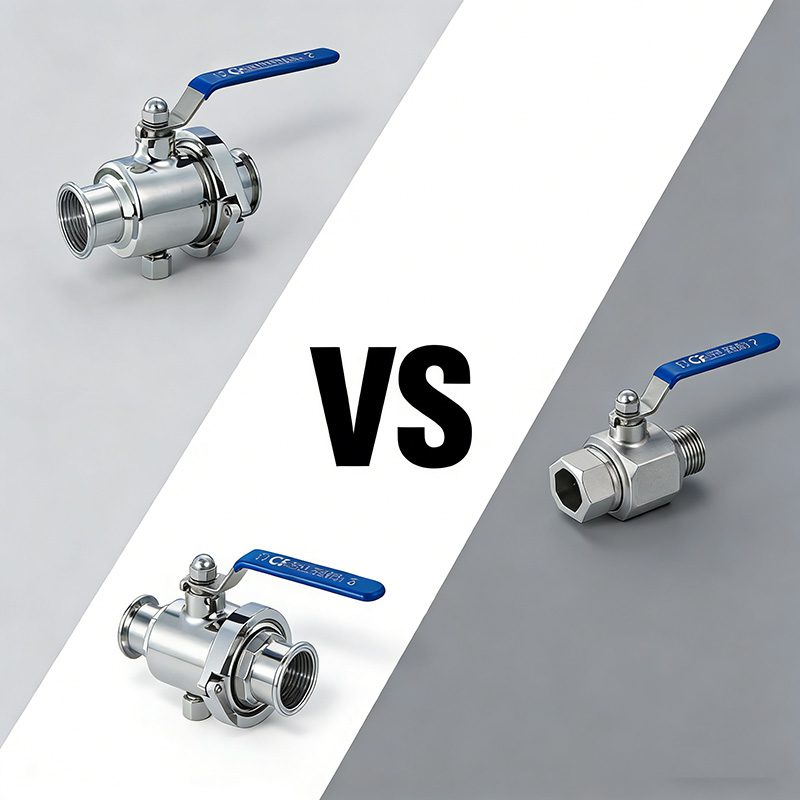
The difference between 1-piece, 2-piece, and 3-piece ball valves lies in their design, advantages, disadvantages, and typical applications. The following provides a detailed explanation.
Design:
The body is a single, solid piece.
The ball and stem are inserted during manufacturing and sealed inside.
Compact, no joints in the body.
Advantages:
Lowest cost among the three types.
Simple, compact design.
Fewer leak points because there are no body joints.
Limitations:
Cannot be disassembled for maintenance or cleaning.
If damaged, the entire valve usually needs replacement.
Typical Applications:
Low-cost residential or light industrial systems.
Non-critical applications where maintenance is minimal.

Design:
Body consists of two parts, joined by threaded or bolted connections.
Ball, seats, and stem can be accessed by removing one end.
Advantages:
Can be partially disassembled for maintenance or seat replacement.
More robust than 1PC valves.
Still relatively compact.
Limitations:
Slightly higher cost than 1PC.
More leak points due to body joint.
Typical Applications:
Industrial piping systems where maintenance may be needed.
HVAC, water treatment, and chemical processes.

Design:
Body consists of three parts: two end caps and a central body.
Ball, seats, and stem are fully accessible without removing the valve from the pipeline.
Advantages:
Fully serviceable without removing the valve from the pipeline.
Seats and seals can be replaced while valve remains installed.
Ideal for critical systems requiring frequent maintenance.
Limitations:
Most expensive of the three types.
Slightly more complex design and heavier than 1PC or 2PC.
Typical Applications:
Chemical, pharmaceutical, oil & gas industries.
Systems with corrosive fluids or frequent maintenance requirements.
1-Piece Ball Valve: Short and Direct
You’ll find that the 1-piece ball valve typically has the shortest structure.
What does this mean for you?
Low installation space requirements, making it particularly suitable for compact equipment, integrated cabinets, or single-use systems.
However, precisely because it’s a “one-piece” design, if the internal seal or ball wears out, you’re faced with replacement, not repair.
From a short-term procurement perspective, it’s very attractive; from a long-term maintenance budget perspective, it’s not so friendly.
2-Piece Ball Valve: Moderate Length, Increased Flexibility
The 2-piece ball valve is slightly longer, but this extra length provides better sealing and compression capabilities.
In practical projects, you’ll find it’s the “default option” in industrial procurement.
You can perform a certain degree of maintenance without dismantling the entire pipeline.
Of course, it’s not “completely user-friendly,” but it strikes a relatively comfortable balance between cost and maintainability.
3-Piece Ball Valve: Longest Structure, but Designed for Maintenance
When you first see a 3-piece ball valve, you might instinctively think:
“This is too complicated!”
Yes, it’s longer, heavier, and has more parts.
But from a total life cycle cost perspective, you’ll gradually understand its value.
The middle valve body can be directly removed without disturbing the pipeline or shutting down the system for too long.
In continuous production, food processing, pharmaceutical, or high-value media scenarios, this is truly invaluable.
Maintenance methods directly determine your hidden costs.
Simpler structures lead to lower initial prices, but don’t necessarily save money in the long run.
3-piece ball valves are better suited for high-value systems, not simply because “expensive is better.”
2-piece ball valves are the most common and often underestimated option.
Your application scenario is always more important than the specifications sheet.
Use this decision table to match your needs:
| Factor | Best Match | Why |
|---|---|---|
| Lowest upfront cost | 1PC | Simplest body, least material and machining |
| Minimal maintenance expected | 1PC or 2PC | Little to no inline service needed |
| Need for occasional seat/stem service/repair | 2PC | Partial disassembly possible |
| Frequent servicing or cleaning required | 3PC | Fully serviceable without removing valve |
| Critical service (hazardous, high cost of failure) | 3PC | Easier maintenance, better uptime |
| Heavy duty industrial use | 2PC / 3PC | Robust construction, better access |
| Compact footprint required | 1PC | Small and lightweight design |
| High corrosion or slurry service | 3PC (with proper materials) | Allows cleaning and replacement |
Q: Is there a significant price difference between 2-piece and 3-piece ball valves?
A: Typically, the difference is in the 10–30% range, depending on the material, pressure rating, and brand positioning.
Q: Is a 1-piece ball valve suitable for long-term use?
A: It is suitable for applications with low maintenance requirements, clean media, and budget constraints, but not suitable for systems requiring frequent maintenance.
Q: Is a 3-piece ball valve always more reliable?
A: The structure is more conducive to maintenance, but reliability still depends on the sealing material and manufacturing quality.
Q: Is it necessary to use only one type of valve structure when purchasing?
A: Not necessarily; many established projects use a mix of different types to control overall costs.
When you truly consider 1-piece, 2-piece, and 3-piece ball valves from a buyer’s perspective, you’ll find that it’s not a question of “which is better,” but rather “which is more suitable for your current system and future plans.”
1-piece ball valves help you lower initial costs, 2-piece ball valves offer a reliable balance, and 3-piece ball valves reduce long-term risks in demanding applications.
If you are comparing supply options or looking to optimize your selection strategy for your next project, it’s worth conducting a thorough evaluation now.
👉 Contact a professional valve supplier to get customized recommendations for your specific application – this step can often save you the most money.

STAINLESS STEEL&GENCEL;
Privacy Policy | SiteMap
Copyright GENCEL STAINLESS STEEL CO.,LIMITED
 Optimized by Seraphinite Accelerator